
The Future is in Focus: Nurturing Innovation and Collaboration in Pediatric Liver Transplantation
The WebApp is sponsored by: 

Early Insights from PeLTQL Integration: A QI Snapshot in Pediatric Liver Transplantation
Kyla McDonald1,2, Karina Kwan2, Maria DeAngelis2, Krista Van Roestel2, Tara MacDonald2, Jennifer Stunguris2, Yaron Avitzur2, Vicky Ng2.
1Psychology, The Hospital for Sick Children, Toronto, ON, Canada; 2Pediatric Liver Transplantation, The Hospital for Sick Children, Toronto, ON, Canada
Early Insights from PeLTQL Integration: A QI Snapshot in Pediatric Liver Transplantation
Introduction. Psychosocial challenges often emerge before and after pediatric liver transplantation. Patient-reported outcome measures (PROMs) such as the Pediatric Liver Transplant Quality of Life (PeLTQL) questionnaire capture patient and family perspectives and provide early-warning signals. We examined our early experience integrating PeLTQL into psychosocial referrals to evaluate how PROM data complements referral questions and informs clinical impressions.
Methods. Thirty-one consecutive referrals to a clinical health psychologist (October 2025–January 2026) were reviewed for referral question, psychologist impression, next steps, PeLTQL completion, and referral–impression concordance.
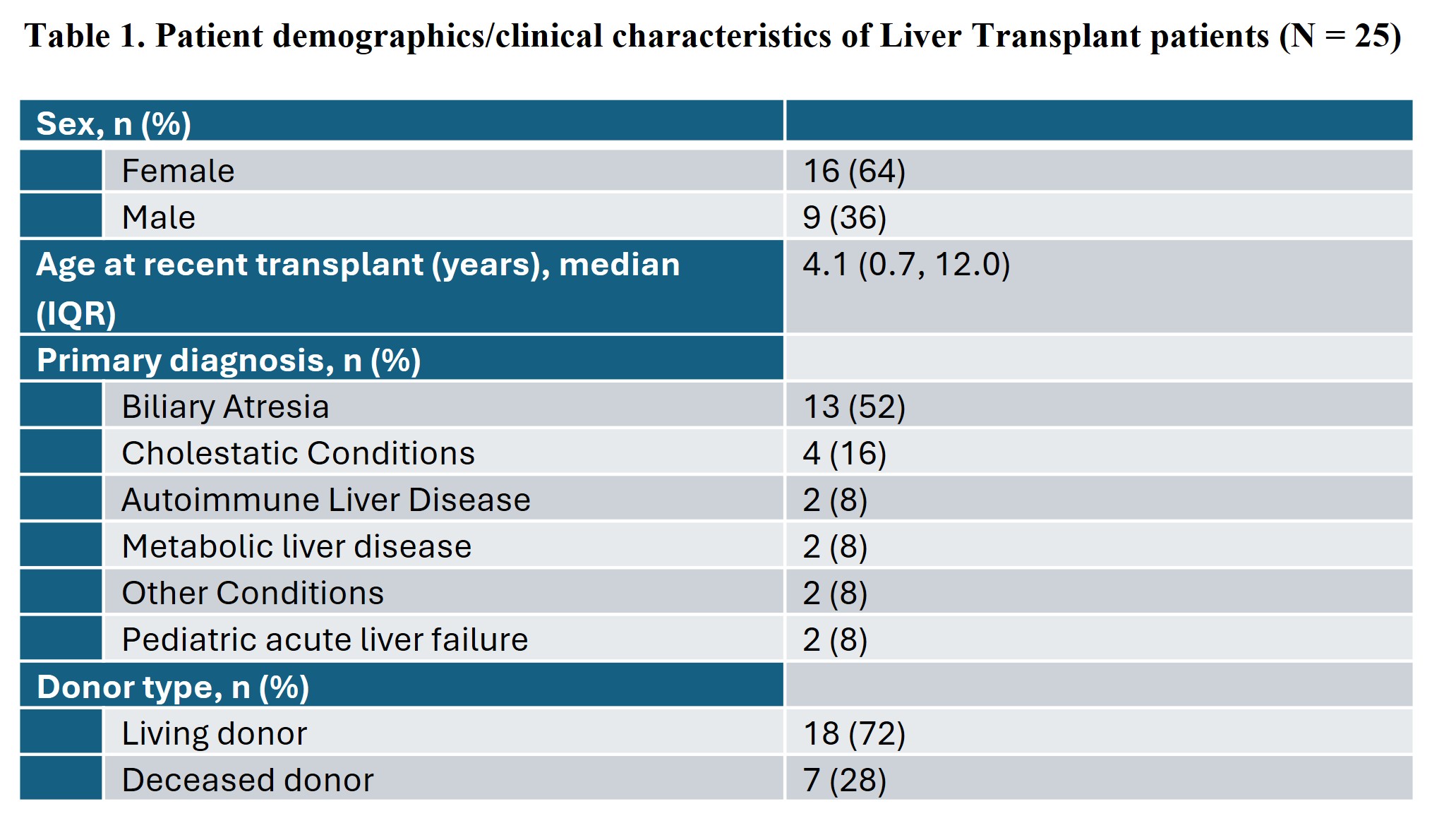
Results. Of 31 referrals, 25 involved transplant recipients; 14 of 15 eligible patients completed PeLTQL. Over half of patient (55.6%) and caregiver (60%) scores fell below the <62.5 threshold, signaling need for follow-up. Referral and psychologist impressions aligned in 71% of cases; scope expanded in 26%, often for anxiety flagged by low scores or caregiver reports. Some referrals broadened to address caregiver needs, developmental concerns, or adherence strategies.
Conclusions. Integrating PeLTQL into routine care surfaces concerns beyond referral questions, enabling proactive triage and tailored interventions. Embedding PROMs within clinical pathways advances patient- and family-centered care and aligns with initiatives to operationalize quality-of-life measurement using digital platforms that return child, parent, and discrepancy scores to clinicians before visits, making PROM signals actionable within routine encounters.



Email: info@splitmeeting.org
If you have any questions during the meeting, please go to the registration desk. Our emails will be monitored sporadically.
REGISTRATION DESK OPENING TIMES